Let’s Talk About Our New Reference Line of Diamond Transistor Integrated Amplifiers: AMP TUNDER MK-ABSOLUTE REFERENCE
Let’s Talk About Our New Reference Line of Diamond Transistor Integrated Amplifiers: AMP TUNDER MK-ABSOLUTE REFERENCE
We’re thrilled to introduce the result of six months of intensive research and development – a Class Ac* transistor amplifier (*contour type). This amplifier represents the peak of our advancements in transistor technology, combining the most cutting-edge innovations we’ve ever achieved.
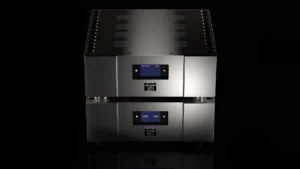
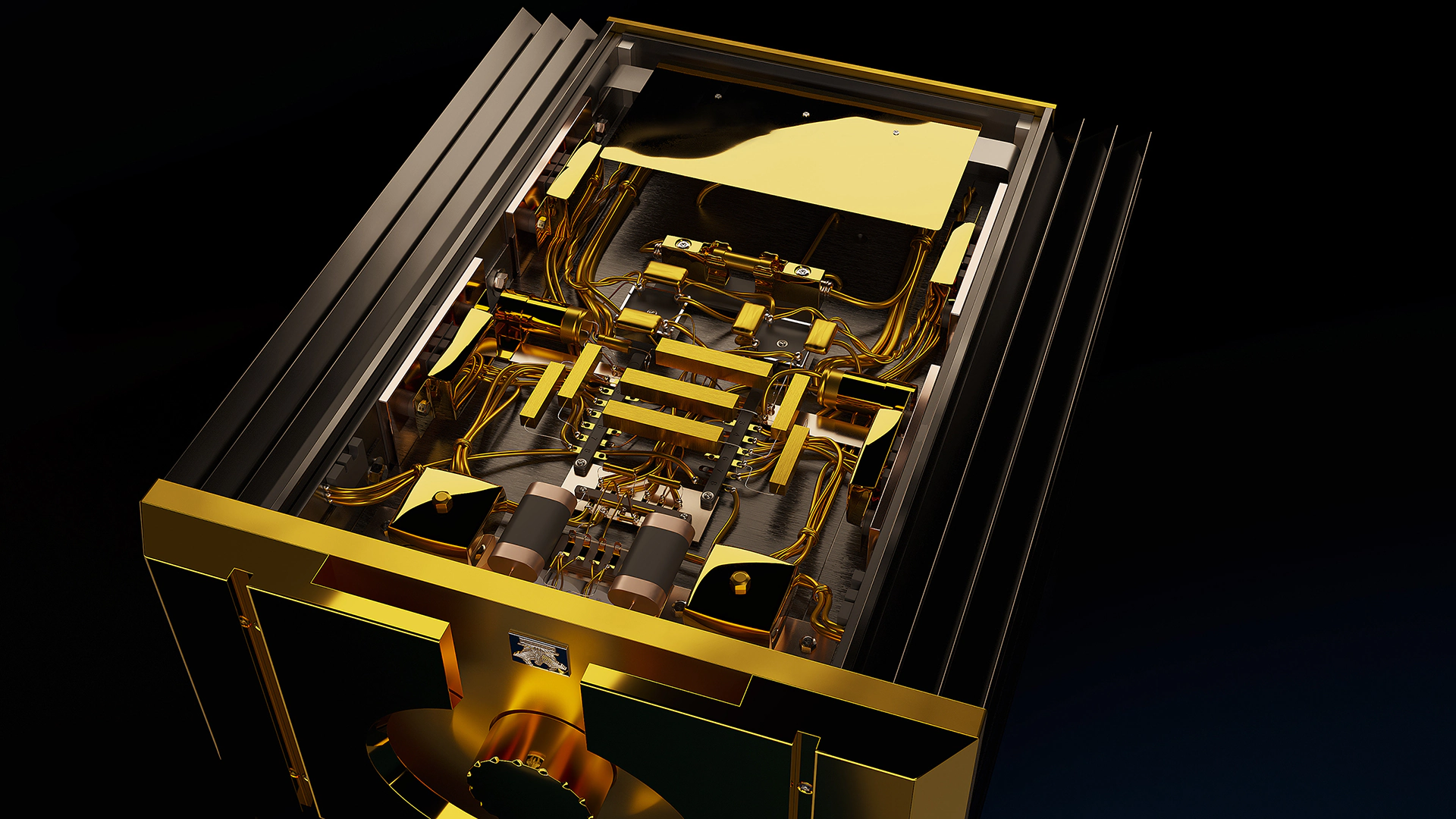
The amplifier is designed with separate left and right channels, each featuring two diamond transistors mounted on copper platforms and encased in caps made from a gold-containing alloy (copper-bronze-brass). The structure of the amplifier is split across two levels: the lower level contains the technical components, including four chokes and a power transformer, while the upper level houses seven transformers and four additional chokes.
Fully balanced, the amplifier only has symmetrical balanced outputs. Essentially, the entire design revolves around transformers. It’s built for continuous operation, able to stay permanently connected to the power grid – just connect a source and feed it a signal.
The front panel is made from pressed aluminum and anodized with 750-grade gold. The volume control knob, weighing 14.11 ounces (400 grams), is crafted from the same gold-containing alloy. The walls, double base, and internal partitions, along with the protective caps and holders for the output capacitors, are all made from gold-containing alloys. The raw “hardware” weighs in at 121.25 lbs (55 kilograms).
The display showcases the operation of the left and right channels, visually representing the frequency response (FR) signal movement. This adds a touch of luxury – an approach that no one else uses, but we’ve made it happen.
In terms of heat management, the amplifier stays virtually cool, thanks to its substantial transformer section, which efficiently dissipates heat and balances it across its components. It delivers 100 watts of power in Class Ac* (*contour type) with ultra-smooth volume control. The entire volume control system operates through transformers, adjusting the volume by generating low-frequency current amplitude.
Our goal was to create a device that’s not just unconventional in design and construction but also resistant to any magnetic interference or field distortions. The amplifier excels in this, completely eliminating all known types of interference without relying on any feedback mechanisms. This is a true representation of the Ultra High-End class.
Comparative Review with Other Brands
VITUS AUDIO MP-L201 MK-II – $74,000
Among the technologies highlighted in the descriptions of this device, the focus is on the casing, which is coated with a polymer glaze. Why? Because the casing is made from powdered waste materials that degrade over time. The polymer coating prevents future deformation during use. In summary, this setup is essentially a large computer, filled with countless standard computer modules that can be replaced like computer boards when they fail.
The power supply is external, designed to avoid introducing irreversible impulse noise into the system. If the power supply were placed inside, the impulse modulation would be so high that any audible sound quality would be compromised. All the boards inside are designed for amplification via microchips, meaning the signal is continuously processed by a computer.
Without the software algorithms, the device cannot function. Forget about analog sound here – the component base is comparable in cost to that of a standard laptop. Cheap materials are used throughout, from the casing to the internals. To produce any semblance of sound without unimaginable distortions, the device relies on constant signal processing via software, functioning like a sound equalizer devoid of linearity.
GOLDMUND TELOS 8800 – $452,000 / Monoblock
Weighing 584.22 lbs (265 kilograms), this metal box measures 44.49 inches (113 centimeters) with radiator fins extending 6.69 inches (17 centimeters) on each side, contributing to its massive weight. Inside, there are only four boards. The entire internal setup is cheaply made. Sixteen transistors, arranged like Christmas lights, will endlessly overheat. The system cannot be cooled effectively because they’re not mounted on specialized radiator brackets but are simply attached in a basic manner. As a result, the heat transfers to the external casing.
The design isn’t focused on sound quality. Instead, four standard capacitors are installed to prevent the transistors from burning out quickly. Additionally, short-circuit regulators are included to avoid circuit interruptions. What’s missing is a proper choke-transformer system, which is entirely absent here. At its core, the product features a refined metal casing, while the internal components consist of a standard amplifier with an estimated value of no more than $500.
DAN D’AGOSTINO RELENTLESS EPIC 1600 MONOBLOCK – $349,500
This device follows the same pattern as the others. The casing houses boards with an endless array of transistors mounted directly onto the walls. The radiator, which should cool the transistors, serves only a decorative function. Inside, you’ll find cheap Epcos capacitors and standard correction boards. The entire internal setup is worth about $100.
In promotional photos, Daniel D’Agostino proudly displays this “masterpiece” under the hood, but what’s inside is a more affordable Chinese transformer and boards crammed with transistors. This is all low-cost computer-grade hardware, incapable of delivering audiophile-grade sound.
ACOUSTICS FM 1811-MKII – $250,000
This is the so-called “pinnacle of pinnacles.” It’s an amplifier that can’t even be compared to a Sherwood or NAD from the 90s. Under the Chinese casing lies a Chinese transformer, and the components are essentially “Lego from AliExpress.” There’s no cooling system whatsoever. To be honest – the total cost of the components is around $50.
Conclusions
After carefully examining the internals and reading the available descriptions of the aforementioned devices, the following statements can be drawn:
– The descriptions emphasize aesthetic elements, such as the glass coating process, while providing little insight into the device’s underlying technology or functionality.
– There’s no mention of the actual construction or the components used.
– Every device features the same cost-efficient polymer capacitors and cement resistors that crumble under pressure and overheat easily.
These descriptions, despite being for different devices, are remarkably similar because, at their core, they share the same internal structure. It’s akin to a concept rendering of a luxury Bentley with a sleek, futuristic design – visually impressive, yet beneath the surface, the mechanics tell a different story. Imagine the driver seated confidently at the wheel, only for the hood to be lifted, revealing a pedal-driven mechanism reminiscent of classic children’s toy cars.
For Those Seeking True Premium Personal Audio Systems, we invite you to watch our video on the ProAudioConsulting Class-Ac Integral Transistor Monoblock AMP TUNDER MK-ABSOLUTE REFERENCE: